
Oklahoma Traffic Court Records
Oklahoma traffic court records are public documents that show citations, case status, court dates, and outcomes for traffic violations filed across the state's 77 counties. You can search them online using the state's free OSCN system or the ODCR portal, which together cover the vast majority of district courts in Oklahoma. Whether you need to look up a specific citation number, check a case status, or find out about a past traffic conviction, this guide explains where to search and what to expect when you access Oklahoma traffic court records.
Oklahoma Traffic Court Records Overview
How to Find Oklahoma Traffic Court Records
Oklahoma traffic court records are kept at the district court level, with one district court serving each of the state's 77 counties. When a driver receives a traffic citation, the case is filed in the district court for the county where the violation occurred. From there, the case gets a docket number and enters the public record. Most of those records are searchable online through two main portals: the official Oklahoma State Courts Network (OSCN) and the privately operated On Demand Court Records (ODCR) system.
Both systems pull from district court data, but they cover different counties and offer different features. OSCN is run by the Oklahoma Supreme Court and is fully free to search. It is the best place to start for cases filed in Oklahoma County, Tulsa County, Cleveland County, and other larger urban counties. ODCR, run by KellPro, Inc., tends to have stronger coverage in rural parts of the state and also provides access to scanned court documents in some cases. For thorough research, it is worth checking both.
Municipal court citations are handled differently. Traffic violations processed through city courts are not on OSCN or ODCR. If you received a ticket from a city police officer in a city with its own municipal court, you need to contact that city court directly. This is a key distinction to keep in mind when you can't find a record on the statewide portals.
Note: Municipal court traffic citations are not available on OSCN or ODCR. If you got a ticket from a city officer, check with the municipal court in that city.
The Oklahoma State Courts Network is maintained by the Oklahoma Supreme Court and serves approximately six million visitors each year. The system covers traffic violations, criminal cases, civil matters, protective orders, and probate records all in one place. Records typically go back to the late 1990s or early 2000s, though coverage varies by county.
Oklahoma State Courts Network (OSCN)
The OSCN portal at oscn.net is the primary tool for searching Oklahoma traffic court records at no cost. It is the official system maintained by the state, and it covers all 77 counties. You can search by name, case number, citation number, attorney name, or date of birth. Once you find a case, the docket shows party names, court dates, case status, and listed charges.
To run a search, go to oscn.net/dockets/Search.aspx. The search page lets you choose a specific county or search across all courts at once. If you have a citation number from a traffic ticket, you can enter it directly to pull up the case. For name searches, entering the last name and first name narrows results quickly. The docket search also lets you filter by case type, which helps when you want to look only at traffic matters and skip other case types.
One thing to know is that OSCN does not provide email alerts when a case is updated. If you need to track a case over time, you have to check back manually. For case-specific questions, contact the county clerk where the case was filed rather than the OSCN help desk, which handles technical issues only.
The OSCN portal was recently captured at oscn.net, showing the main court records interface used by millions of Oklahoma residents each year.
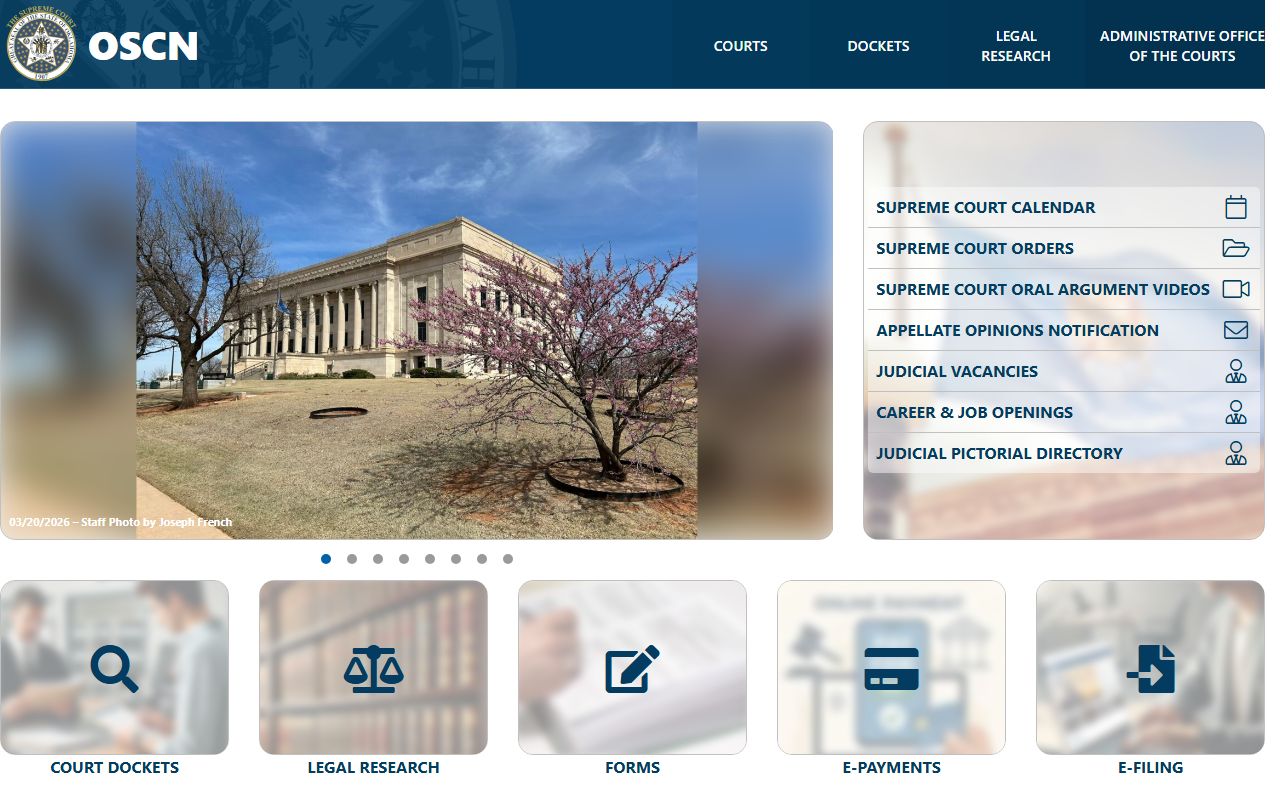
The OSCN homepage provides direct access to docket searches, appellate records, and the e-payments system from a single landing page.
The docket search interface at OSCN Docket Search makes it easy to find cases by county, case number, or party name.
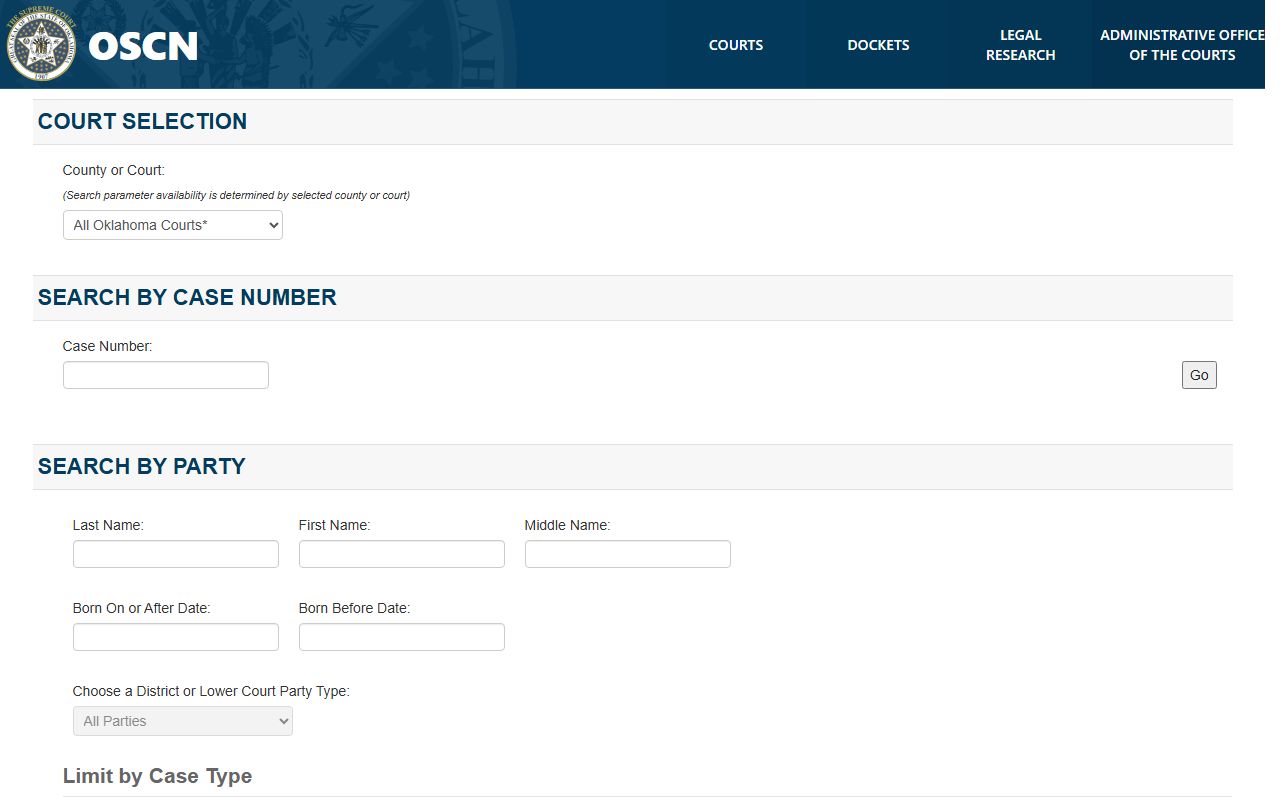
From the docket search page, you can filter results by court type, case number format, and date range to narrow your search quickly.
ODCR - On Demand Court Records
On Demand Court Records (ODCR) is operated by KellPro, Inc. as a private portal that covers 70 or more Oklahoma counties, with a focus on rural district courts and tribal courts. Basic searching on ODCR is free. You can look up cases by name, case number, or filed date range without paying anything. The free tier gives you full docket information, which includes case status, charges, and court dates.
Where ODCR stands out is its access to scanned court documents. OSCN has limited document imaging, but ODCR often has the actual filed papers in scanned form. For attorneys and legal professionals who are active bar members, ODCR offers unrestricted image access to download and print full case filings. For general users, an advanced tools subscription at five dollars per month gives you no-ad searches, date of birth filtering, outstanding warrant filters, offense and cause searches, and case monitoring features. The free access tier is enough for most basic lookups.
Visit odcr.com to search participating courts. The search interface at odcr.com search portal includes fields for court group, party name in Last-First format, case type, case number, and filed date range.
The ODCR main portal at odcr.com provides access to court records from over 70 Oklahoma counties and tribal courts.
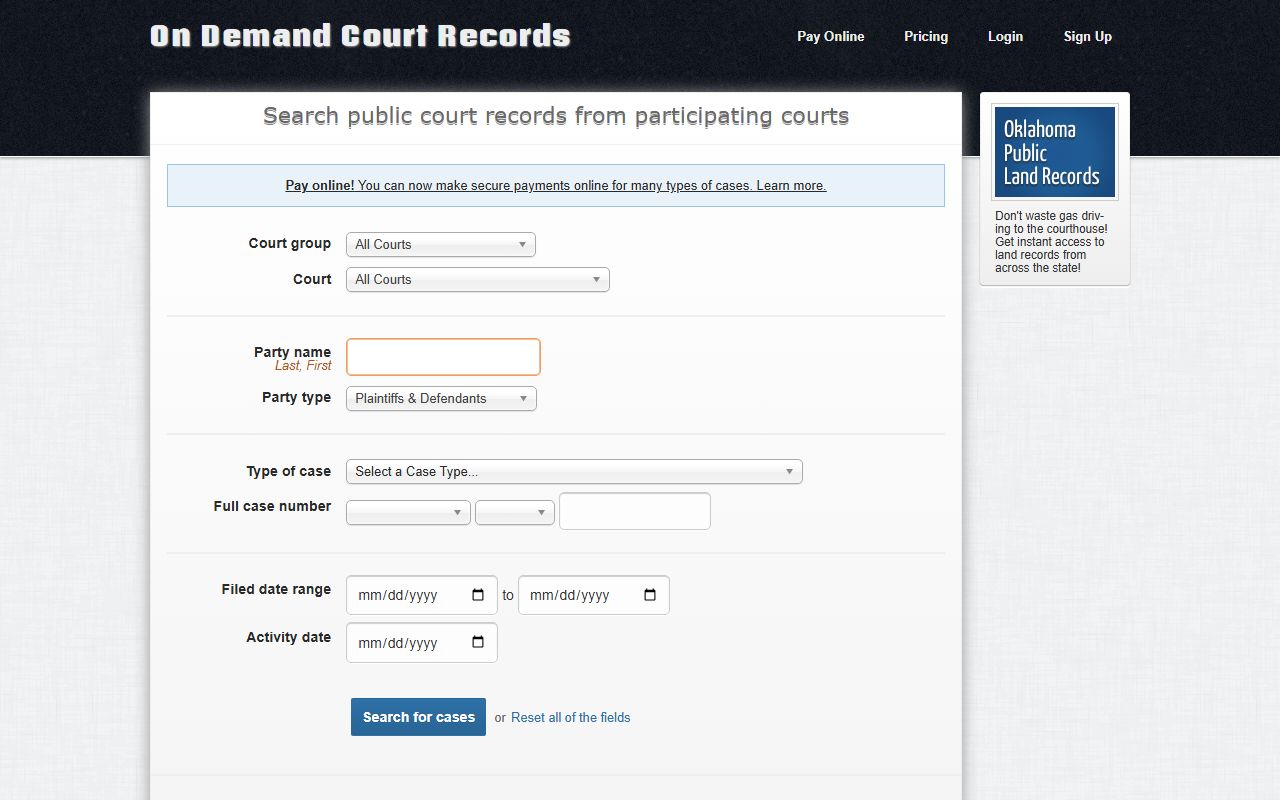
ODCR covers mostly rural Oklahoma counties and tribal courts that may not be fully represented in the OSCN system.
The ODCR search interface lets you search by name, case number, or date range across all participating courts at odcr.com.
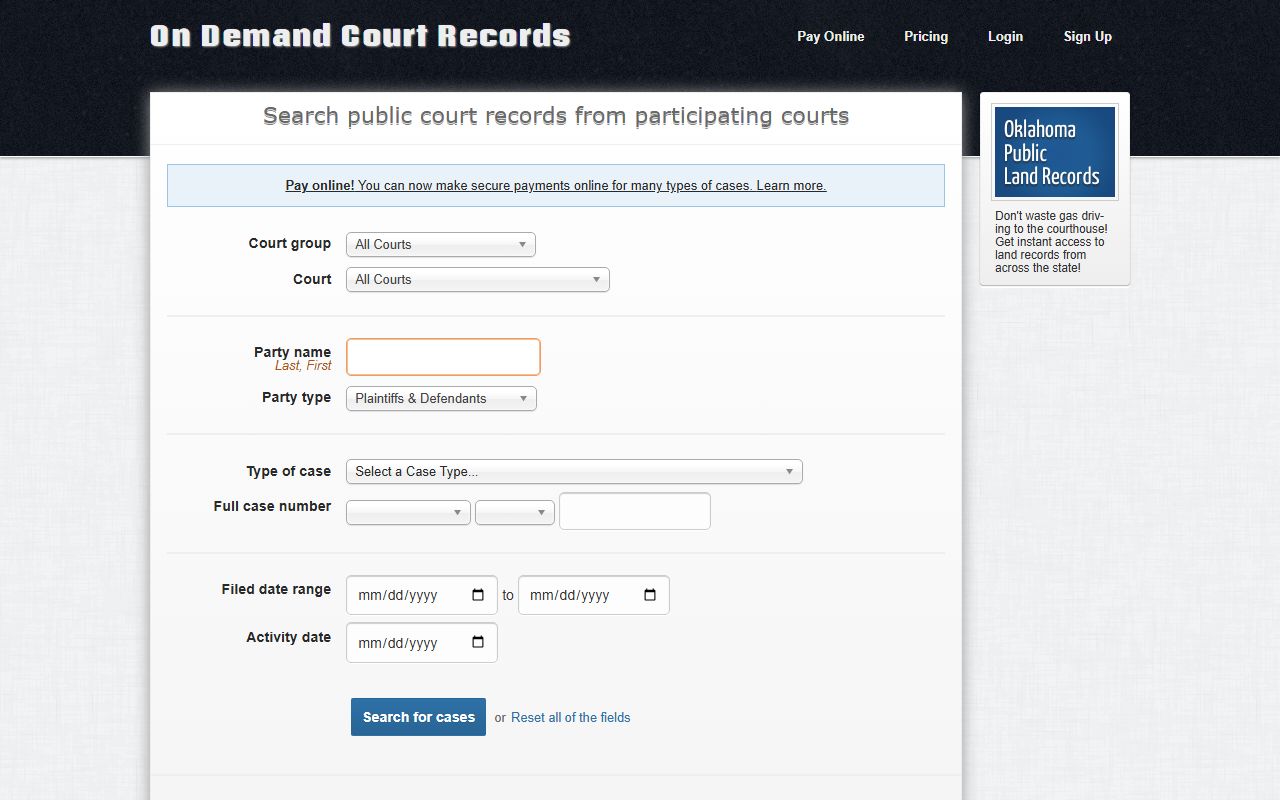
The search portal at ODCR lets you filter by court group, case type, and date range for faster results.
Knowing when to use each portal saves time. OSCN is best for major metro counties and free document access. ODCR covers more rural counties and has scanned filings that OSCN may not.
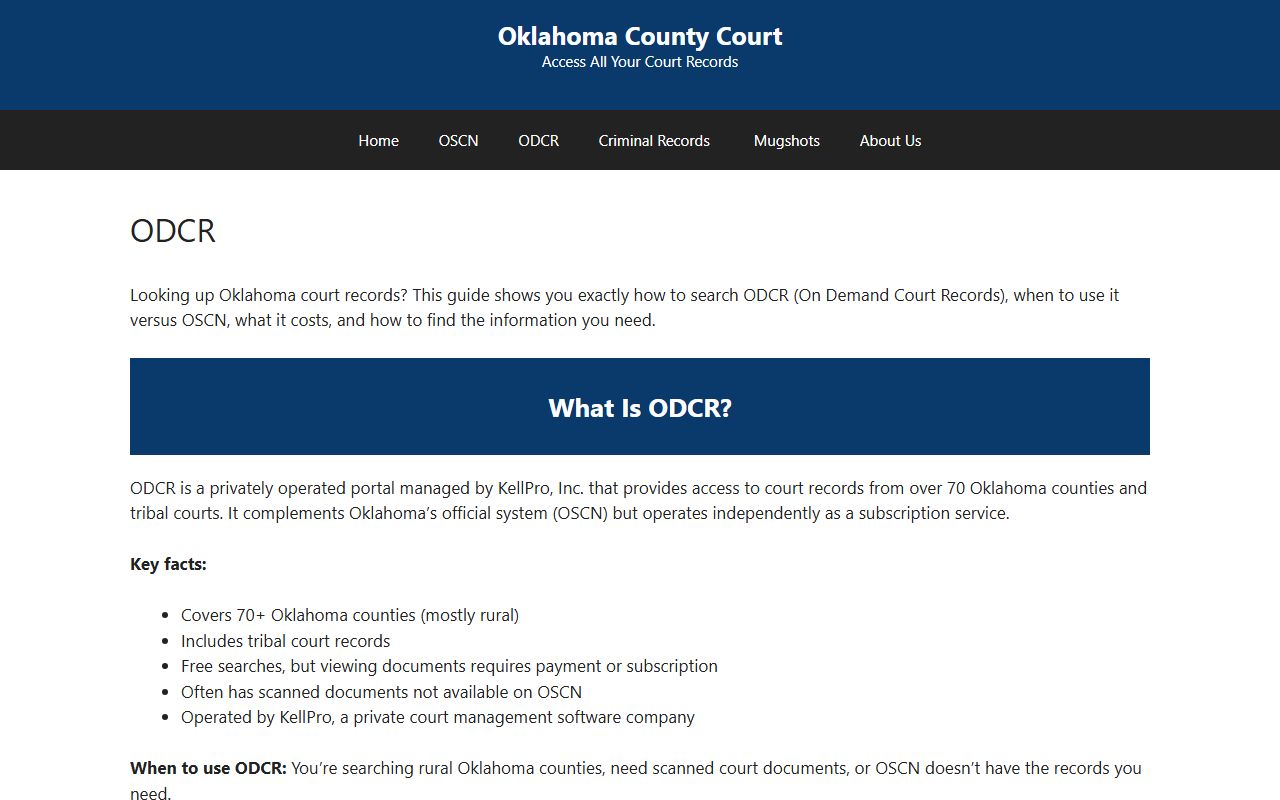
For most researchers, the best approach is to check both OSCN and ODCR since records don't always sync perfectly between the two systems.
Online Payment for Traffic Citations
Oklahoma offers an online payment system for traffic citations through the OSCN E-Payments portal at pay.oscn.net/epayments/find. This system covers all 77 Oklahoma counties. To pay a citation online, you need the case number, citation number, or payment plan number. The citation number from a traffic ticket is usually the fastest way to locate the case in the payment system.
Citation numbers follow specific formats. A traffic citation number might look like M972124. Court case numbers use formats like CM-2017-100 for misdemeanor cases. Payment plan numbers use the format PP-OK-2019-25. If you don't have any of these numbers handy, the portal has a lookup feature to help find your case. Municipal and sheriff's office citations use slightly different number formats, so be aware of that if the standard lookup doesn't return results.
One important warning: if a warrant has been issued on your case, paying online will not recall the warrant automatically. You must contact the court clerk after making the payment to have the warrant addressed. Also, online payments can take 24 to 72 hours to appear in the system, so don't assume something went wrong right away if your payment doesn't show up immediately.
The OSCN E-Payments system at pay.oscn.net allows drivers to pay traffic citations online without visiting the courthouse.
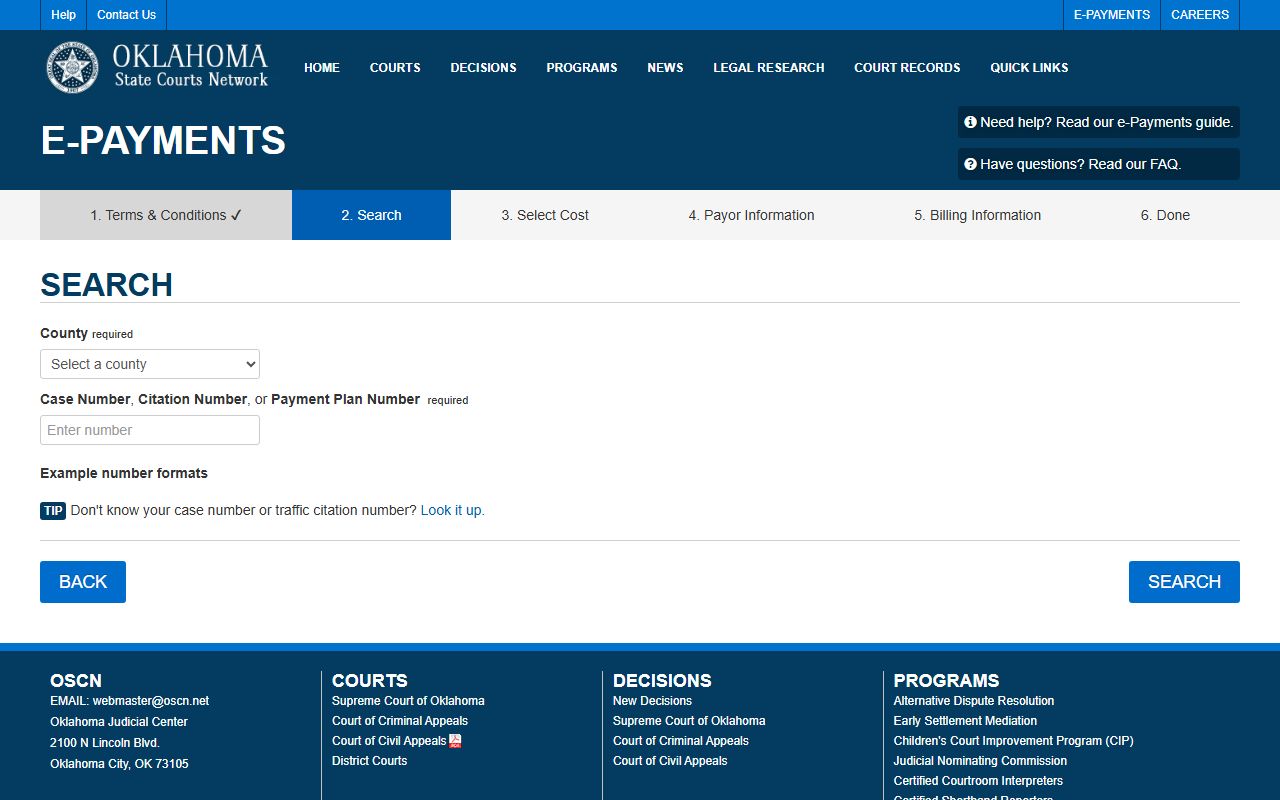
The e-payments portal accepts case numbers, citation numbers, and payment plan numbers to locate cases eligible for online payment.
Traffic Violation Points System in Oklahoma
Oklahoma uses a Mandatory Point System managed by Service Oklahoma (formerly the Department of Public Safety) to track driving behavior. Every time a driver is convicted of a pointable traffic violation, points are added to their driving record. Reach 10 or more points within a five-year period and the state will suspend your license. The point system applies to convictions in any court with authority over traffic violations, not just Oklahoma courts.
Point values vary based on the offense. Reckless driving and failure to stop for a school bus each carry 4 points. Speeding violations are tiered: going 1 to 10 mph over the limit carries no points but still results in a fine. Going 11 to 25 mph over adds 2 points. A 26 to 40 mph violation adds 3 points. Going 41 mph or more over the limit adds 4 points. At-fault accidents and improper passing each add 3 points. Violation of a license restriction, careless driving, following too closely, failing to obey a stop sign or traffic light, failure to yield, and going the wrong way on a one-way street all add 2 points each. Operating a defective vehicle and failure to signal each add 1 point.
There are ways to reduce points. Completing an approved defensive driving course removes 2 points from your record, though this option is only available once every 24 months. Going 12 months without any point-related violations automatically reduces your record by 2 points. If you go three full years without a pointable violation, your points reset to zero entirely.
Suspension lengths also get longer with repeated offenses. A first point suspension lasts one month. A second suspension lasts three months, a third lasts six months, and a fourth or later suspension lasts 12 months. See the full point schedule at law.justia.com.
The Oklahoma point system as documented by Justia Law outlines all traffic violations and their corresponding point values under Title 47.
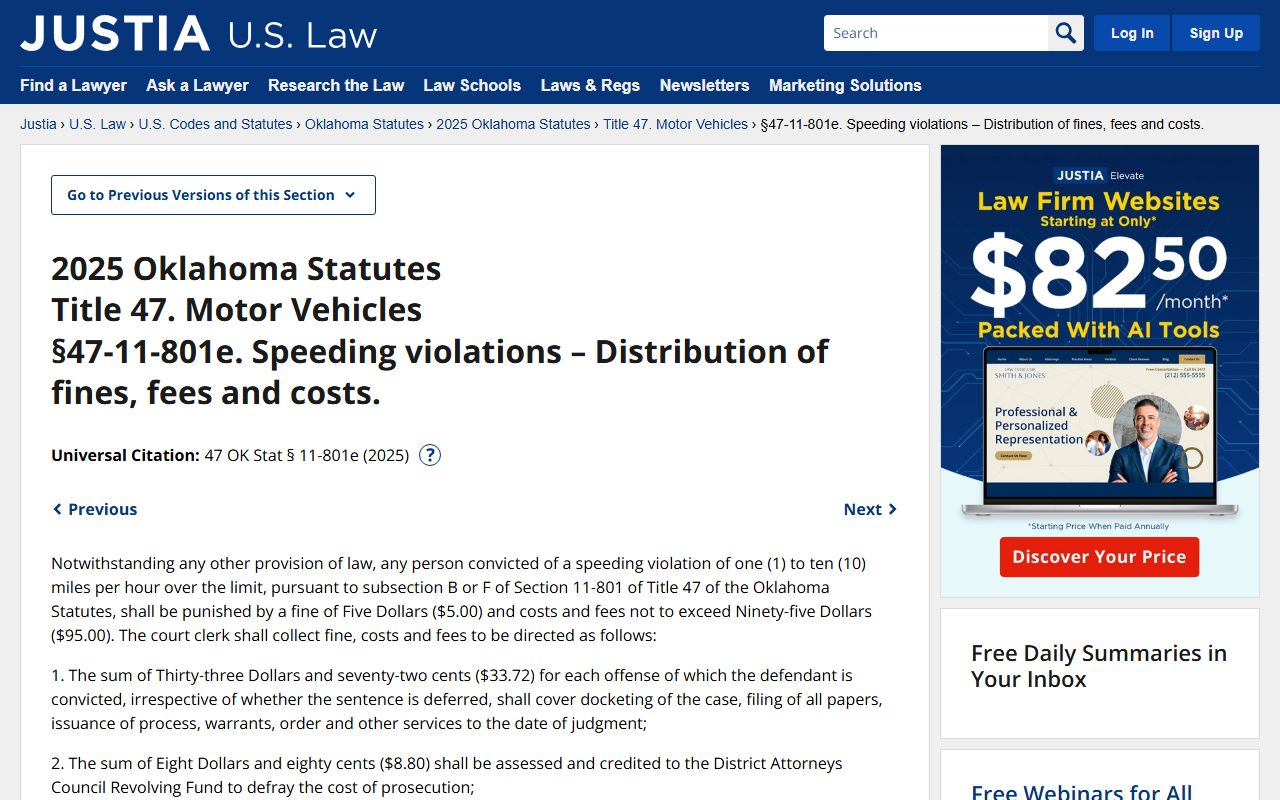
The mandatory point system is tracked through your driving record at Service Oklahoma and can result in license suspension once the 10-point threshold is crossed.
An accessible breakdown of the point system is also available at klf-law.com, covering each violation type and the corresponding point value.
Each pointable violation category carries specific consequences, and drivers who reach 10 points face an automatic license suspension.
Understanding Oklahoma Traffic Laws
Traffic law in Oklahoma falls primarily under Title 47 of the Oklahoma Statutes, which covers motor vehicles and all related regulations. Title 47 is a large body of law covering speed limits, licensing, equipment standards, and court procedures for traffic violations. The statute is available as a PDF from the Oklahoma Senate website, though it is a lengthy document. Key sections that affect traffic court records are Sections 11-801 through 11-806.1.
Section 47-11-801 sets the basic speed rule and the framework for speed limit enforcement. It establishes that no person may drive at a speed greater than is reasonable and prudent under current road conditions, regardless of posted limits. Section 47-11-801e specifically addresses how fines and fees from speeding convictions are distributed. That distribution includes amounts going to the DA Council Revolving Fund, the Oklahoma Court Information System, courthouse security, victim services, child abuse programs, and CLEET (Council on Law Enforcement Education and Training).
Construction zone and school zone violations carry doubled fines. Under 47 O.S. Section 11-806, speeding in an active construction zone doubles the standard fine. School zone violations during posted times are covered under 47 O.S. Section 11-806.1 and also carry double fines. Most school zones set speeds at 25 mph, with some at 15 mph. These zones are marked with signs that meet the federal Manual on Uniform Traffic Control Devices standards. More details on zone violations are at oktrafficticket.com.
The zone violations guide at oktrafficticket.com covers the doubled fines that apply in school and construction zones under Oklahoma law.

Construction and school zone fines are doubled under Oklahoma statute, making zone violations significantly more expensive than standard speeding tickets.
District Courts vs Municipal Courts in Oklahoma
Oklahoma has two separate court systems that handle traffic violations, and knowing the difference matters when you are trying to find records. District courts are the state-level trial courts. Each of the 77 counties has one district court, and these courts handle the full range of traffic offenses including misdemeanor and felony traffic matters. District court records are accessible through OSCN and ODCR. When you search those portals, you are only looking at district court cases.
Municipal courts are city-level courts that handle minor traffic violations and city ordinance matters. Many cities in Oklahoma have their own municipal court, and citations issued by city police officers often go through those courts rather than the district court. Municipal court records are not on OSCN or ODCR. To find records from a municipal court, you need to contact the city clerk or municipal court clerk directly for that city. Some cities have their own online lookup tools, but many don't.
This gap is the most common reason people can't find a traffic record online. If you got a ticket from a city officer in a city that has a municipal court, and you search OSCN without finding anything, the record may simply be in the municipal court system instead. Always confirm which court handled the case before assuming the record doesn't exist.
Note: The newer Oklahoma Unified Case Management System (OUCMS) is being developed to eventually replace both OSCN and ODCR, though as of now only one county operates on that system.
Browse Oklahoma Traffic Court Records by Location
Oklahoma traffic court records are filed at the district court level in each of the state's 77 counties. Select a county below to find local court contact information and resources for traffic records in that area.
Traffic Court Records in Major Oklahoma Cities
Residents of larger Oklahoma cities may file or receive citations handled through their county district court or a local municipal court. Pick a city below to find resources for traffic court records in that area.